Is it legal to record a conversation?
Usually yes, if you’re part of it. Federal law and most states let one person in the conversation agree to the recording, and that person can be you. Thirteen states ask for everyone’s agreement, for phone calls, conversations in person, or both. Recording a conversation you’re not part of, without anyone’s consent, is generally illegal everywhere in the US. Below is every state in plain English, with its law linked.
Checked by Sricharan, who started Dewby.
This is general information, not legal advice. Laws change and courts read them differently, so check the law linked for your state, and ask a lawyer if a lot rides on it.
| State | In person, who must agree | On a call, who must agree | What to know |
|---|---|---|---|
| Alabama | One person | One person | Ala. Code §§ 13A-11-30, 13A-11-31 |
| Alaska | One person | One person | Alaska Stat. § 42.20.310 |
| Arizona | One person | One person | Ariz. Rev. Stat. § 13-3005 |
| Arkansas | One person | One person | Ark. Code Ann. § 5-60-120 |
| California | Everyone | Everyone | Everyone must agree before a confidential conversation is recorded; calls involving a cellphone need everyone’s consent even if not confidential. Conversations where people expect to be overheard are not covered.Cal. Penal Code §§ 632, 632.7 |
| Colorado | One person | One person | Colo. Rev. Stat. §§ 18-9-303, 18-9-304 |
| Connecticut | One person | Everyone | In person, one party’s consent is enough. Recording a phone call requires everyone’s consent, a recorded notice at the start of the call, or a repeating beep tone.Conn. Gen. Stat. §§ 53a-187, 53a-189; § 52-570d |
| Delaware | Everyone | Everyone | Delaware’s main recording law allows recording with one party’s consent, but a separate privacy law requires everyone’s consent, and the two have not been reconciled.Del. Code Ann. tit. 11, § 1335(a)(4); § 2402(c)(4) |
| District of Columbia | One person | One person | D.C. Code § 23-542 |
| Florida | Everyone | Everyone | Everyone must agree before a phone call or a private in-person conversation is recorded; conversations where people have no reasonable expectation of privacy are not covered.Fla. Stat. § 934.03(2)(d) |
| Georgia | One person | One person | Ga. Code Ann. §§ 16-11-62, 16-11-66(a) |
| Hawaii | It depends | One person | One party’s consent is generally enough, but using a recording device in a private place, such as a home, requires consent of everyone entitled to privacy there.Haw. Rev. Stat. § 803-42(b)(3)(A); § 711-1111(1)(d) |
| Idaho | One person | One person | Idaho Code § 18-6702(2)(d) |
| Illinois | Everyone | Everyone | Secretly recording a private conversation or call needs everyone’s consent; an exception covers recording someone you reasonably suspect of committing a crime against you or your household.720 ILCS 5/14-2(a)(2); 5/14-3(i) |
| Indiana | One person | One person | Indiana’s recording law covers phone and electronic communications; no state statute specifically addresses recording in-person conversations.Ind. Code §§ 35-31.5-2-176, 35-33.5-5-5 |
| Iowa | One person | One person | Iowa Code §§ 808B.2(2)(c), 727.8 |
| Kansas | One person | One person | Kan. Stat. Ann. § 21-6101(a)(1), (a)(4) |
| Kentucky | One person | One person | Ky. Rev. Stat. §§ 526.010, 526.020 |
| Louisiana | One person | One person | Since 2026, using smart glasses to record or transcribe an in-person conversation requires notifying everyone, with exceptions such as your own home, car, or workplace.La. Rev. Stat. § 15:1303(C)(4); § 9:2790.3 |
| Maine | One person | One person | Me. Rev. Stat. tit. 15, §§ 709, 710 |
| Maryland | Everyone | Everyone | Everyone must agree before a phone call or a private in-person conversation is recorded; conversations with no reasonable expectation of privacy are not covered.Md. Code Ann., Cts. & Jud. Proc. § 10-402(c)(3) |
| Massachusetts | Everyone | Everyone | Secretly recording any conversation is a crime, even in public; recording openly, where everyone knows, does not require formal consent.Mass. Gen. Laws ch. 272, § 99 |
| Michigan | It depends | One person | The law reads as all-party, but a state appeals court held participants may record their own conversations; a separate law bars recording devices in private places without consent.Mich. Comp. Laws §§ 750.539a, 750.539c, 750.539d |
| Minnesota | One person | One person | Minn. Stat. § 626A.02, subd. 2(d) |
| Mississippi | One person | One person | Miss. Code Ann. § 41-29-531(e) |
| Missouri | It depends | One person | Phone calls need one party’s consent. The in-person rule reaches only devices that transmit by radio, and for those the law has no exception for participants.Mo. Rev. Stat. § 542.402.1(2), 542.402.2(3) |
| Montana | Everyone | Everyone | Recording with a hidden device requires that everyone knows; giving a warning is enough, and people speaking at public meetings are exempt.Mont. Code Ann. § 45-8-213(1)(c), (2)(a) |
| Nebraska | One person | One person | Neb. Rev. Stat. § 86-290(2)(c) |
| Nevada | One person | Everyone | Phone calls need everyone’s consent under a state supreme court ruling; in-person conversations need one party’s consent.Nev. Rev. Stat. §§ 200.620, 200.650 |
| New Hampshire | Everyone | Everyone | Everyone must agree before a phone call or a private conversation is recorded; conversations where people have no reasonable expectation of privacy are not covered.N.H. Rev. Stat. Ann. § 570-A:2 |
| New Jersey | One person | One person | N.J. Stat. Ann. § 2A:156A-4(d) |
| New Mexico | One person | One person | New Mexico’s law covers phone lines; no state statute addresses recording in-person conversations.N.M. Stat. Ann. § 30-12-1 |
| New York | One person | One person | N.Y. Penal Law §§ 250.00, 250.05 |
| North Carolina | One person | One person | N.C. Gen. Stat. § 15A-287 |
| North Dakota | One person | One person | N.D. Cent. Code § 12.1-15-02 |
| Ohio | One person | One person | Ohio Rev. Code § 2933.52 |
| Oklahoma | One person | One person | Okla. Stat. tit. 13, § 176.4 |
| Oregon | Everyone | One person | Everyone must be specifically told before an in-person conversation is recorded; phone calls need one party’s consent. Open recording at public meetings and events is exempt.Or. Rev. Stat. § 165.540(1)(a), (1)(c) |
| Pennsylvania | Everyone | Everyone | Everyone must agree before a phone call or a private in-person conversation is recorded; conversations where people have no reasonable expectation of privacy are not covered.18 Pa. Cons. Stat. §§ 5703, 5704(4) |
| Rhode Island | One person | One person | R.I. Gen. Laws § 11-35-21 |
| South Carolina | One person | One person | S.C. Code Ann. § 17-30-30 |
| South Dakota | One person | One person | S.D. Codified Laws § 23A-35A-20 |
| Tennessee | One person | One person | Tenn. Code Ann. § 39-13-601(b)(5) |
| Texas | One person | One person | Tex. Penal Code § 16.02 |
| Utah | One person | One person | Utah Code § 77-23a-4 |
| Vermont | One person | One person | Vermont has no general recording statute, so the federal one-party rule applies; since 2026, recording a telehealth or phone visit with a health provider needs both sides’ consent.No state recording statute; 18 U.S.C. § 2511(2)(d); 18 V.S.A. §§ 9361(d), 9362(d) |
| Virginia | One person | One person | Va. Code Ann. § 19.2-62(B)(2) |
| Washington | Everyone | Everyone | Everyone must agree before a private conversation or call is recorded; announcing the recording to everyone, with the announcement captured on the recording, counts as consent.Wash. Rev. Code § 9.73.030 |
| West Virginia | One person | One person | W. Va. Code § 62-1D-3(e) |
| Wisconsin | One person | One person | Wis. Stat. § 968.31(2)(c) |
| Wyoming | One person | One person | Wyo. Stat. Ann. § 7-3-702(b)(iv) |
One person, or everyone.
Recording laws come in two kinds. In a one-party consent state, it’s enough that one person in the conversation agrees, and that can be you. In an all-party (or two-party) consent state, everyone has to agree. Some states set different rules for phone calls and for conversations in person, and many protect only conversations where people reasonably expect privacy.
The states that ask for everyone.
For phone calls: California, Connecticut, Delaware, Florida, Illinois, Maryland, Massachusetts, Montana, Nevada, New Hampshire, Pennsylvania and Washington. For conversations in person: California, Delaware, Florida, Illinois, Maryland, Massachusetts, Montana, New Hampshire, Oregon, Pennsylvania and Washington, and in some situations Hawaii, Michigan and Missouri. The details differ. Massachusetts bans secret recording. Montana and Oregon ask that people be told. And Delaware’s two laws disagree with each other.
Calls across state lines.
When the people on a call are in different states, it’s hard to know in advance which state’s law a court will apply. The Digital Media Law Project’s advice is to play it safe: if anyone on the call might be in an all-party state, get everyone’s agreement.
Conversations you’re not part of.
Recording other people’s conversation, when you aren’t in it and nobody has agreed, is generally illegal under federal law and in every state. That includes leaving a phone or a device running in a room to catch what people say after you leave.
New rules for wearables.
Laws are starting to name wearable recorders. Since 2026, Louisiana says everyone must be told before smart glasses record or write down a conversation. Vermont says both sides must agree before a video or phone visit with a health provider is recorded. Similar bills are moving in other states, so check the date at the top of this page.
Just ask.
Whatever your state’s rule, asking first is simple and decent: “Mind if I record this so I don’t miss anything?” Record where people can see it, too. In some states, that decides whether a conversation counts as private at all. Our guide to recording an in-person meeting has more on what to say.
Where Dewby fits.
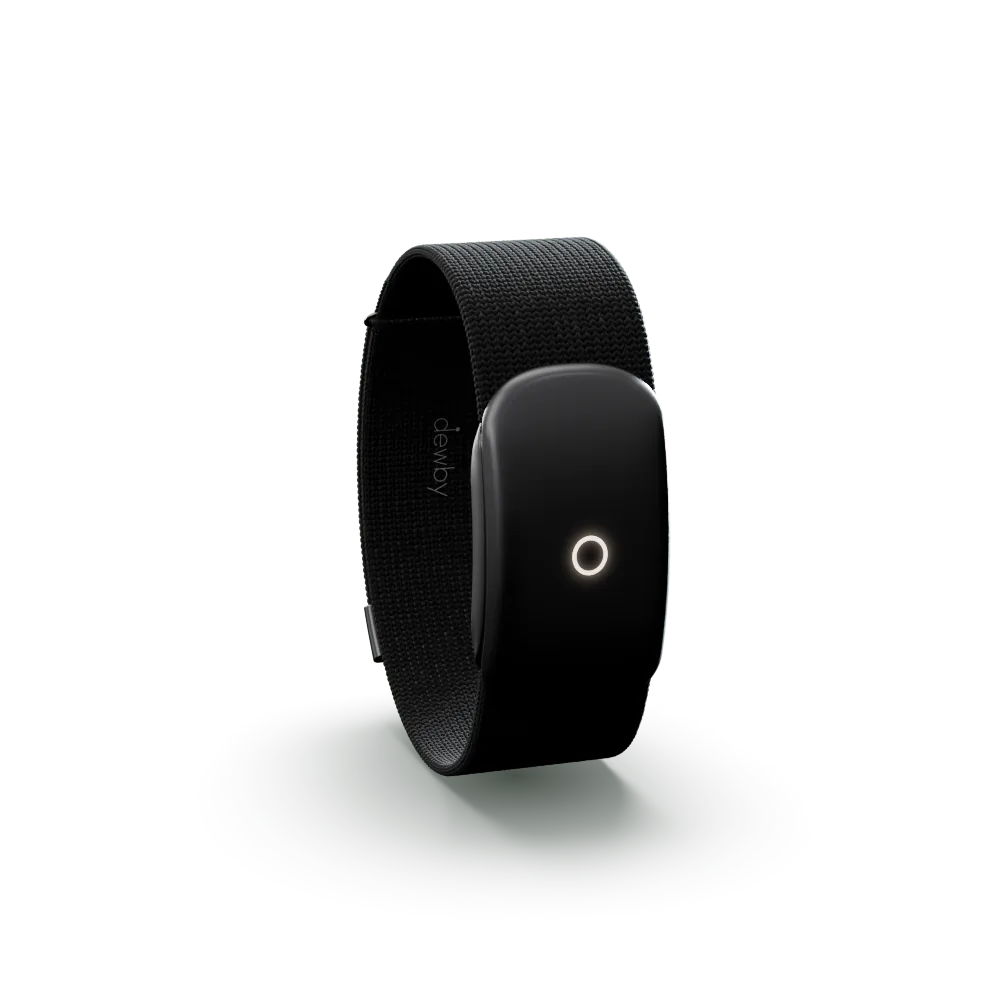
We make Dewby, so take this part with that in mind. Dewby listens only when you choose, and a ring of light on the band shows when it’s on. It’s designed to recognize your voice and keep only your words as notes. But it can’t stop the microphone from hearing other people, so it doesn’t replace asking. In the states above, tell people before it listens.
Questions.
Is it illegal to record someone without their permission?
It depends on where you are and whether you’re part of the conversation. In most states you can record a conversation you’re in without telling anyone. In thirteen states, everyone must agree, at least for calls or for conversations in person. Recording a conversation you’re not part of, without anyone’s consent, is generally illegal everywhere in the US.
Which states are two-party consent states?
For phone calls: California, Connecticut, Delaware, Florida, Illinois, Maryland, Massachusetts, Montana, Nevada, New Hampshire, Pennsylvania and Washington. For conversations in person, Oregon joins the list and Connecticut and Nevada drop off, and Hawaii, Michigan and Missouri require it in some situations.
Are Texas and New York one-party consent states?
Yes. In both, one person in the conversation, which can be you, can agree to a recording, for phone calls and in person.
Can I record a phone call?
If you’re on the call and everyone is in a one-party state, generally yes. If anyone on the call is in an all-party state, tell everyone at the start and carry on only if they agree.
Does federal law override state law?
No. Federal law sets the floor: one person’s consent is enough, unless the recording is made to commit a crime or a tort. States can be stricter, and when both apply, follow the stricter one.
Can I record a meeting at work?
The same state rules apply, and your employer may have its own policy on top. Recording a meeting you’re in is legal in one-party states, but it can still break a workplace rule, so ask first.
Related.
Sources.
- 18 U.S.C. § 2511, the federal wiretap lawlaw.cornell.edu
- Reporters Committee for Freedom of the Press: Reporter’s Recording Guidercfp.org
- Digital Media Law Project: recording phone calls and conversationsdmlp.org
- Kilpatrick Townsend: 50-state wiretap laws chart (July 2024)ktslaw.com
- Louisiana R.S. 9:2790.3: notice for recording with smart glasseslegis.la.gov
- Vermont Act 80 (2026)legislature.vermont.gov
- ABA Journal: Ninth Circuit upholds Oregon’s recording law (2025)abajournal.com
- Supreme Court docket 24-1061: review denied, October 6, 2025supremecourt.gov
Something out of date? Write to hello@heydewby.com and we’ll correct it.